Editorial Book Reviews
A Clockwork Universe (URUT)
A brief look into concepts presented in
A Clockwork Universe: URUT (Unified Rotating Universe Theory)
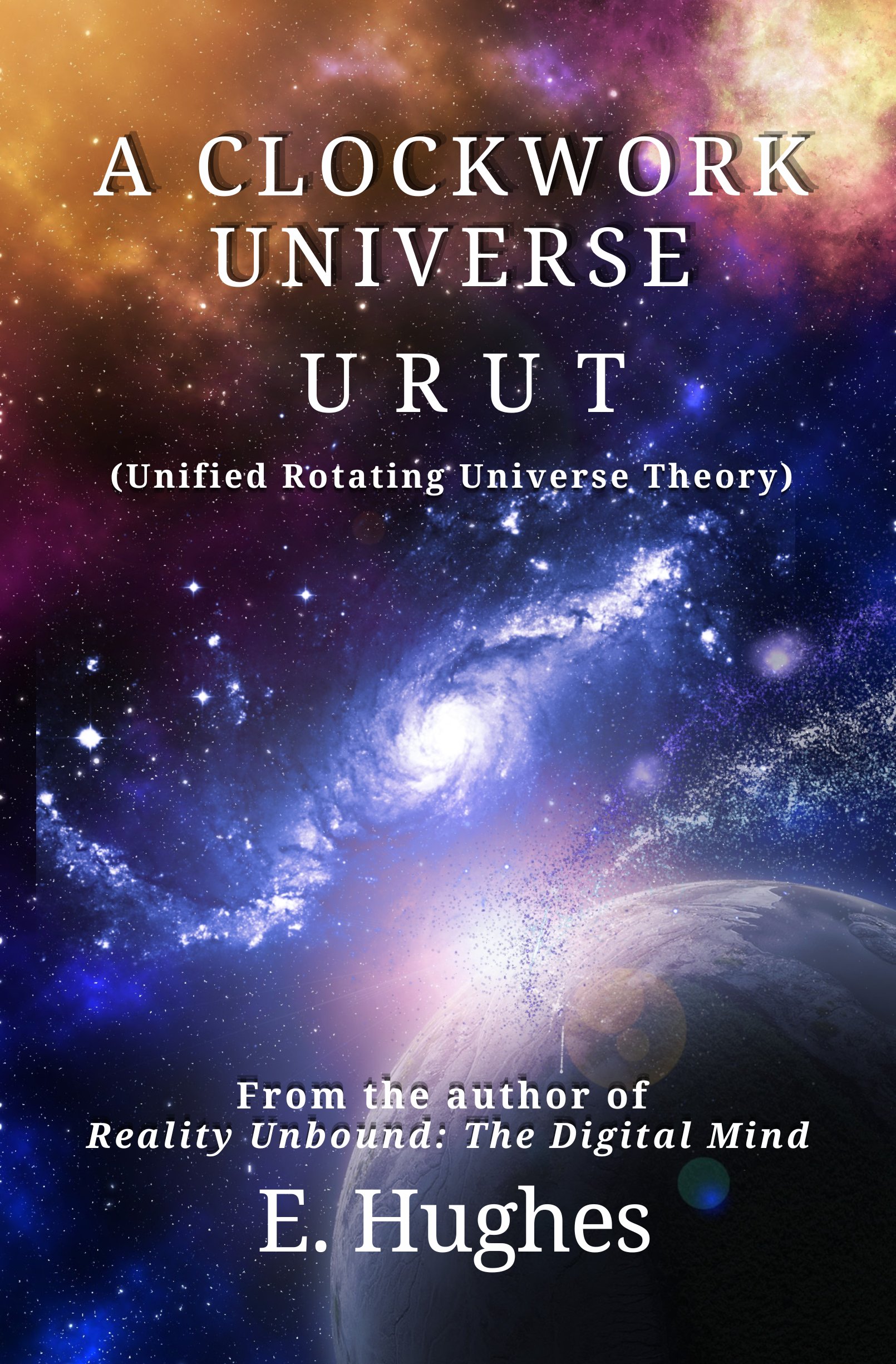
AClockwork Universe presents Unified Rotating Universe Theory as a cosmological model built around rotation as the organizing principle of physical reality. Hughes begins by rejecting space as an independent container, defining it instead as distance created after matter gives location meaning. From that starting point, URUT imagines the universe as a rotating disc whose larger motion guides galaxies while galaxies guide the systems inside them. The book then turns to the proto-universe, described as an ultra-hypermassive star whose instability creates entropy before expansion gives space its first definition. Hughes continues from gravitational motion into cosmic observation before reaching quantum reality and the nature of time across its chapters, presenting one argument that motion is the key to how the universe behaves.
E. Hughes’s A Clockwork Universe presents the universe as a vast working clock, with rotation setting the movement of everything within it across every scale. Hughes teaches the belief that rotation links several questions about the universe, which is timely as readers increasingly question how scientific explanations are formed. Hughes writes in a friendly, accessible way, using everyday pictures to explain bigger ideas. Hughes is clearly knowledgeable in everything presented, but the entire book is also exhaustively researched. Hughes draws on published studies and philosophical writing, like Gödel on the rotating universe discussion, and Eddington’s arrow of time supporting the argument. Readers who are well-versed as well as non-specialists will find this a brilliant way to consider how the universe moves, and how time works.
Looking up at the night sky, at the glowing moon, dazzling constellations, and the vast dark void stretching between them, it is easy to wonder what truly fills that infinite expanse.
American astronomer and planetary scientist Carl Sagan once said, "Even these stars, which seem so numerous, are as sand, as dust - or less than dust - in the enormity of the space, in which there is nothing."
From the legendary art of Michelangelo to the novelist, poet, and playwright Jules Gabriel Verne, author of the famed De la terre à la lune, the allure of the universe has captivated humanity since time immemorial. Along with that imagination, philosophers have debated its existence, its purpose, and ultimately, our place within it.
In A Clockwork Universe, author and metaphysicist E. Hughes offers a compelling exploration of the cosmos in, a Unified Rotating Universe Theory (URUT). Hughes grounds URUT in philosophical history, drawing on the foundational ideas of Newton, Leibniz, Albert Einstein, and René Descartes alongside astronomical breakthroughs from Vera Rubin, Kent Ford, and Edwin Hubble.
After laying the groundwork on dark matter and the cosmic edge in the opening chapters, Hughes dives deep into complex territory, tackling expansion, gravity, time, and the origins of the universe, while adding some perspective on quantum physics. Despite the heavy subject matter, Hughes keeps the material engaging and accessible for non-experts, using diagrams, mathematical steps, and detailed research.
A Clockwork Universe is a complex, thought-provoking analysis and reassessment of established scientific data. It presents a collaboration of concepts that serve as a bridge between rigorous philosophical scientific analysis, and the mysteries of the cosmos for a curious reader exploring the universe.
A Clockwork Universe earns a recommendation from me.
★★★★★ – Elijah B. (Explore Authors Magazine)
AClockwork Universe by E. Hughes is a concise work of metaphysics and cosmology that revisits some of humanity's oldest questions about space, motion, gravity, time, and the structure of the universe. Hughes describes the book as an examination of "the nature of nature," which captures its approach well. Drawing on the history of philosophy, classical and modern physics, astronomy, and contemporary cosmological research, the book develops a mechanistic view of the universe centered on rotation and relational motion. Its scope is broad, but the writing remains approachable, inviting readers into a philosophical inquiry.
One of the book's most distinctive features is its reconsideration of concepts that are often treated as settled or self-evident. Hughes asks readers to think carefully about what we mean when we use words such as space, time, gravity, expansion, and dimension, and whether the models used to describe physical reality should ever be confused with physical reality itself. URUT places particular emphasis on the distinction between mathematical description and tangible phenomena, while still drawing on established scientific observations and research. The result is a work that moves between Descartes, Einstein, Gödel, astronomy, thermodynamics, and more recent cosmological studies while maintaining a consistent philosophical focus.
Hughes writes in a direct, conversational style and frequently uses thought experiments and familiar physical relationships to make difficult ideas easier to visualize. That accessibility is one of the book's strengths. The discussion can move from the history of cosmology to questions about the nature of space or the meaning of time without feeling like a survey course. Instead, the chapters build on one another as parts of a larger examination of whether the universe might be understood through motion, rotation, emergence, and observable relationships. The book also leaves room for the reader to question, test, and reflect on its ideas.
I'd recommend A Clockwork Universe to readers who enjoy metaphysics, cosmology, the philosophy of science, and serious examinations of foundational ideas. It should be especially engaging for people who are interested in Einstein, Gödel, the history of cosmological thought, or the relationship between mathematical models and physical reality. Readers who enjoy books that ask them to reconsider familiar concepts from a different philosophical perspective will find a great deal to think about here. Hughes invites the reader into a larger conversation about how we understand the universe and our place within it, while leaving enough unanswered on the page to make discovering URUT firsthand part of the experience.
The origin of our universe remains a mystery. It has been the subject of many theories and much speculation, but nothing has been proven. E. Hughes brings a philosophical and metaphysical perspective to the debate in A Clockwork Universe: URUT (Unified Rotating Universe Theory). The book examines the various hypotheses that stretch from the ancient Greek philosophers to Descartes, Newton, Einstein, and others. Early understanding viewed Earth as the center of the universe, a stance supported by the church. As science evolved, we gained knowledge through astronomy and physics that ultimately gave rise to the “Big Bang” and other theories, but our understanding remains incomplete. These theories are contrasted with URUT, which is essentially a mechanistic view, hence the analogy to clockwork.
The universe is portrayed as a rotating disc, with space as the relational distance between objects. Interestingly, in terms of URUT thinking, space is inside the universe and not the converse. The universe expands as it rotates, and there are no stationary bodies in space. The relationship between space and matter is explored, as well as the concept of time. The notion of dark energy is discounted as unproven, and the author points out that dark matter is not the same as dark energy. Black holes are explained, along with the nature of light and time travel, noting that the universe has a finite life.
A Clockwork Universe is an exploration of cosmology. E. Hughes uses her extensive knowledge of philosophy and physics in a unique blend to promote a new understanding through the Unified Rotating Universe Theory (URUT). She points out that our concept of time is flawed and limited by our narrow frame of reference. We also lack the tools to measure time and related phenomena in a universal context. Using clues that can be found in the past, the book examines why we reached the current level of understanding. The author asserts that life is bigger than the individual. The vastness of the cosmos and its finite nature remind us that our existence is both precious and yet fragile. She reflects on our shared reality and how our consciousness shapes and enriches the universe, despite its limitations. The book includes notes on URUT concepts and a list of sources. The writing tone is scholarly, but it is not aimed at being a scientific text, and should be seen as an exploration of nature. Due to its complex and technical subject matter, it may not appeal to the average reader, but will provide food for thought for the scientifically minded.
Book Reviews of A Clockwork Universe: URUT (Unified Rotating Universe Theory)
by E. Hughes
Order the book today: via Amazon , Barnes and Noble, and fine retailers everywhere.
URUT Quick Facts
- Time is Constant Time is universally always in the present.
- Variable Motion The speed and behavior of matter moving through space varies, not time itself.
- The Illusion Time lapsing more slowly is an illusion of changing matter properties.