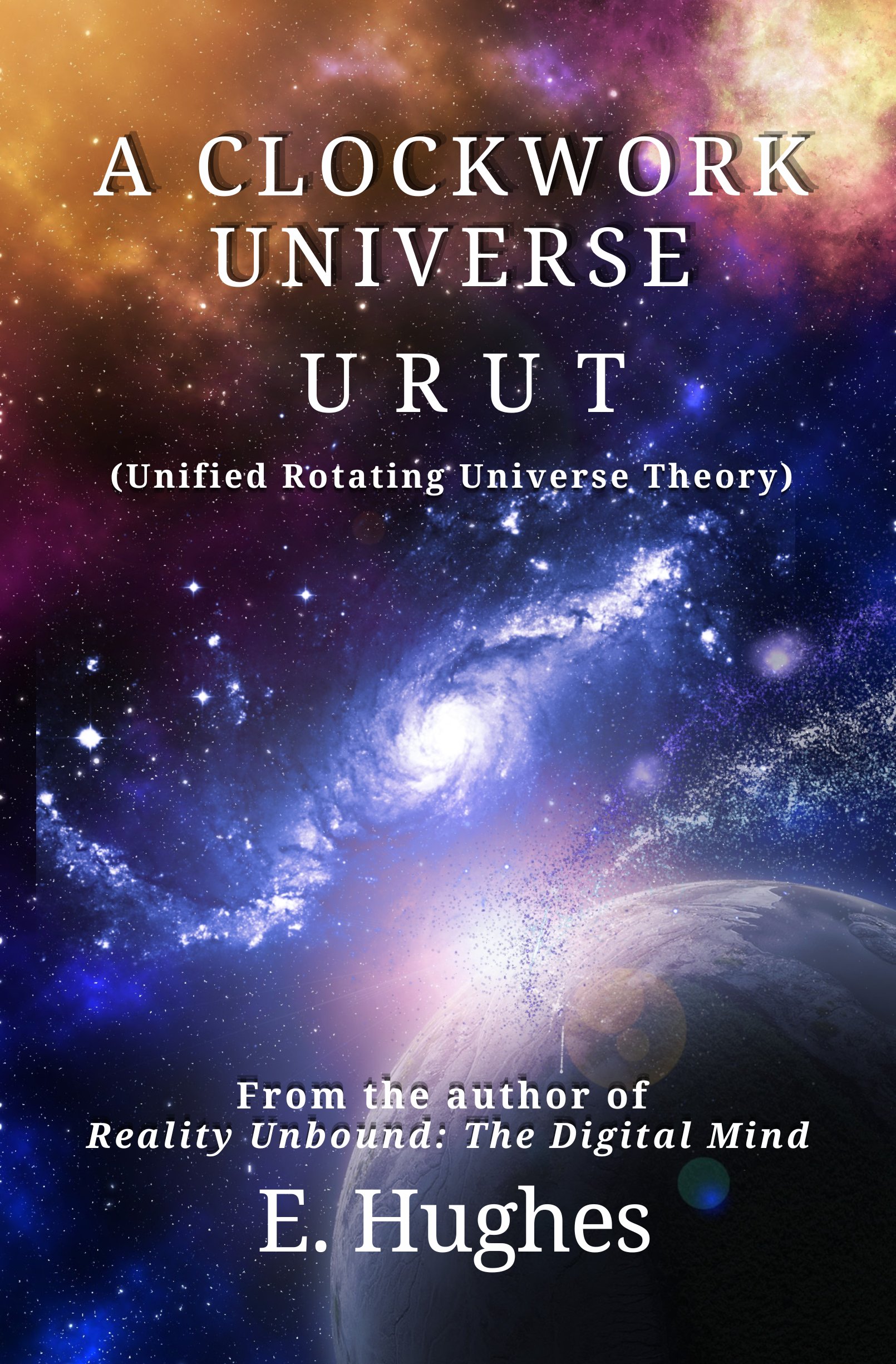
A CLOCKWORK
UNIVERSE
"A Clockwork Universe: URUT"
by E. Hughes
The countdown begins. Order today.
A Clockwork Universe: URUT explores the possibility of a rotating universe, challenging modern narratives on dark matter, dark energy, and the Big Bang from a historical and philosophical perspective.
Drawing from recent and historical data, URUT establishes a rotational cosmological framework, taking a dialectical approach to Einstein's Relativity, Gödel's Rotating Universe, and Newton's Mechanical Universe. URUT offers a tangible, mechanical view of the cosmos that doesn't build its premise from abstract mathematical principles, but natural phenomenon and evidence-supported observation that will challenge our current understanding of the cosmos. What is wave-time? | Can we unify physics and general relativity? | What is space? | Was there really a "Big Bang?" Learn more in A Clockwork Universe: URUT (Unified Rotating Universe Theory).
Traveling through time and space to bookstores in 2026.
Scroll down to learn more.
Barnes and Noble
|
Amazon
|
Books-a-Million
|
Bookshop.org
|
Alibris
"Science does not find its origins inside of a lab. It began at the edge of a philosopher’s pen. Mathematics is the early work of ancient philosophy. Computer science is a masterstroke of philosophical genius in the form of logic with origins dating back to the 17th century to early 20th century. Philosophy is the language of ideas. Science is the method used to verify its truths."
- E. Hughes
(A Clockwork Universe: URUT)
A Brief Overview of History
In early 1905 and 1915 respectively, Relativity: The Special and General Theory by Albert Einstein not only gave us new revolutionary theories about the universe, such as identifying the speed of light as a constant, gravity as a curvature or warping of spacetime, and the world's most famous equation, E=mc2, Einstein transformed our understanding of physics and the universe.
In the 1920s, Catholic priest and astronomer Georges Lemaître recognized expansion of the universe and hypothesized that the universe began in a hot, dense state that he called an "hypothesis of the primeval atom." Today, we call it The Big Bang.
Years later, in 1929, Edwin Hubble's research on light from distant galaxies shifting from white to red (red shifting) would eventually lead to observations that the universe is expanding as a result of a mysterious force called "dark energy."
In the 1970s, scientists Vera Rubin and Kent Ford's observation of fast-moving stars at the edge of rotating galaxies led to confirmation of a theory that galaxies were held together by a mysterious medium called, "dark matter." Dark matter was originally coined by astrophysicist, Fritz Zwicky in the 1930s.
In the 1990s, Hubble's data found additional support from new research that determined expansion of the universe is not only occurring, but accelerating.
In light of this brief overview of history, what if the universe did not begin with The Big Bang? What if the universe wasn't expanding because of a dark, unobserved, mysterious force like dark energy? What if the universe wasn't held together by an unobserved medium like dark matter, but was held together by a different source?
E. Hughes offers a radical new theory on the origins of the universe, dark energy, space, and motion in A Clockwork Universe: URUT. Read more below for current hypotheses on the universe.
Dark Matter
A hypothetical invisible source of gravity that makes up 27% of the universe. It does not emit light or energy, yet its gravitational pull holds galaxies together against the forces of expansion. A Clockwork Universe proposes a different theory within the URUT framework. Dark matter has not been observed or formally discovered after decades of research.
Dark Energy
A hypothetical mysterious force that acts as a "cosmological constant," accelerating the expansion of space itself, thought to account for roughly 68% of the universe. Dark energy has not been directly observed or "found" after decades of research. A Clockwork Universe proposes a different theory for expansion of the universe within the URUT framework.
Gravity
More than just a force, Einstein's Relativity describes the very curvature of spacetime. The URUT framework describes a rotational mechanism as part of the engine driving the forces of gravity rather than a "curvature of spacetime."
Wave-Time
A description of the past, present, and future not as "time," but as wave-like continously shifting temporal states.
Space
In the URUT framework, space is the relational distance between two objects. Space is in the universe, the universe is not in space.
Rotating Universe
Within the URUT framework, there is a directed nested rotational hierarchy to physical reality: the Universe directs the rotation of → Galaxies → Solar Systems → Central Sun -→ Planets → Moons → and other matter. URUT is not a Leibniz or Newtonian pre-deterministic model of the universe.
Time
Within the URUT framework: time is always "now." Time is the constant. Change in matter and motion is the variable.
Closed Universe
This is a closed universe. This means the universe is not flat, but curved. A flat open universe is infinite. A closed curved universe is finite.
Universal Entropy
The universe and expansion is the result of entropy. When the universe's rotation is exhausted, and there is more space and distance than the amount of matter in existence, the universe will have cooled, achieved uniform absolute zero temperature, and dies. Rotation at this stage has ceased and the universe will collapse under its own mass.
URUT: Traveling Through Time
Prepare for a journey that challenges our understanding of the beginning. A Clockwork Universe presents a new perspective on the mechanics of a rotational universe.
About the Author
E. Hughes is a metaphysicist and author of over twenty years. Her analytical treatises synthesize classic philosophical logic with mechanical physics to explore cosmology, simulated realities, and the nature of existence.
Her recent publications include, Reality Unbound: The Digital Mind (and the Nature of Reality), for which Hughes is a 2025 Eric Hoffer Book Award Grand-Prize finalist, and an Eric Hoffer Book Award category winner , The Absence of Reality: Aphorisms and Observations on the Nature of Reality and Existence, philosophical poetry book Space, Time, and Loneliness, and Time and the Multi-Universe: A philosophy of time and time travel.