Time Dilation
within the URUT Framework
A sneak peek into the revolutionary concepts presented in
A Clockwork Universe: URUT (Unified Rotating Universe Theory)
In Einstein’s relativity, time is relative. However, in URUT time dilation is considered a change in motion and matter rather than time itself. Time is the constant and is universally always in the present. The speed and behavior of matter moving through space is what varies. Time lapsing more slowly is an illusion. A hypothetical ship traveling through space at the speed of light (using Gödel’s thought experiment) is simply traversing space faster than time can pass.
When we say that time slows down, we sensationalize time, making it an exotic feature of reality when it simply measures the speed or velocity of matter or energy in motion relative to the distance it travels. Visualize it this way:
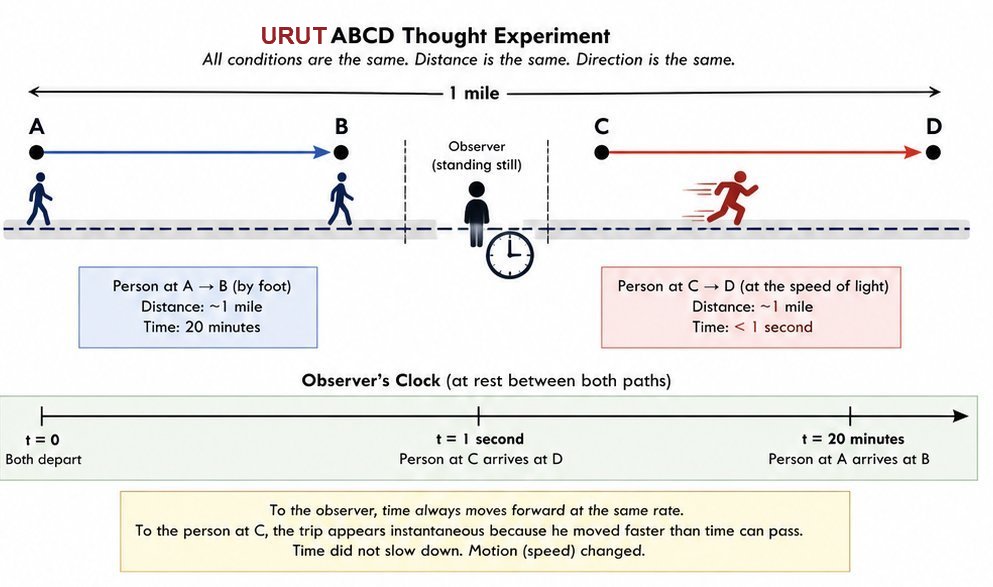
Two people travel one mile. See illustration below.
The One Mile Journey
Q.) Did time move more slowly for the person at Point C?
A.) In URUT, time remained constant. What changed was the velocity that Person C traversed space, faster than a second could elapse. During the experiment, the neutral observer’s clock does not slow down. Person A and C changed position.
The illustration below shows time pointing forward, two people in motion. Time does not slow down if the object or person accelerates. Person C also does not travel to the future. Using Einstein’s train and lightning thought experiment of a train in motion as lightning strikes, the observer’s time remains constant. Information took longer to reach the observer relative to the train’s motion.
GPS satellites and atomic clocks in space tick roughly 45 microseconds faster than clocks on earth due to weaker gravity. There were also experiments in which a particle that decays within an approximate timeframe was accelerated to nearly the speed of light. When accelerated, the particle was found to decay more slowly, leading researchers to cite the experiment as evidence of time dilation.
I am asserting that this is not evidence of time itself slowing down but the properties of matter shifting under changing external conditions erroneously attributed to time changing rather than the object or particle itself. Acceleration or other factors may have altered how the particle functions under extreme conditions. It is more likely that a particle can change how fast it decays, than a temporal change to time itself. Objects in space, like atomic clocks, may tick faster due to speed, weaker gravity, or even temperature changes that affect how the atoms in the atomic clock vibrate, similar to how temperature fluctuations cause quartz watches on earth to slow down over time.
Of course, I am not objecting or questioning whether clocks slow down in space, as this is demonstrably verified by research. I am questioning the interpretation of the data. Is local “time” or the backdrop of “time” truly changing, or are mechanical manmade devices changing under extreme conditions? If so, this isn’t evidence of local or universal time slowing down, but a change in the property of matter.
Excerpt from A Clockwork Universe: URUT (Unified Rotating Universe Theory)
by E. Hughes
URUT Quick Facts
- Time is Constant Time is universally always in the present.
- Variable Motion The speed and behavior of matter moving through space varies, not time itself.
- The Illusion Time lapsing more slowly is an illusion of changing matter properties.